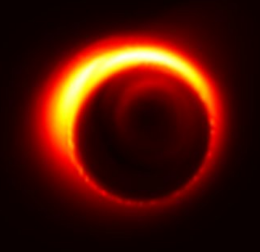
Have you ever thought of black holes not just as colossal star-eaters, but also as potential sources of inexhaustible energy? Well, a team of physicists recently demonstrated that extracting energy from a black hole is not just a sci-fi fantasy, but a physical reality, reproduced right in the lab. This is a spectacular validation of a half-century-old theory!
Black Holes and “Synthetic” Rotation
Researchers managed to recreate the conditions necessary for extracting energy from a black hole using a stationary device, far from the cosmic monsters that spin at incredible speeds. The secret? So-called “synthetic rotation.” Essentially, instead of physically rotating matter, the device uses an extreme Doppler effect, based on the Floquet phenomenon, to amplify waves. This allowed for wave amplification through interaction with an “engineered” synthetic rotation, as shown by studies published in Nature.
Penrose’s Theory Comes to Life
This discovery is not just a simple engineering feat, but an experimental validation of a theory formulated 50 years ago by the renowned Sir Roger Penrose. He postulated that energy could be extracted from spiraling black holes, largely due to intense rotations. What seemed at the time like a bold and purely theoretical idea has now been demonstrated in the controlled environment of a laboratory.
How Did They Do It?
The research team at CUNY ASRC resorted to innovative solutions. They used metamaterials — artificial materials with unusual properties — and intelligent spatiotemporal modulation. These techniques allowed them to simulate, in a way, rotation speeds that even exceed the speed of light, creating the ideal conditions to observe and confirm the energy extraction mechanism.
Did you know…?
- Q: What is the Floquet Doppler effect?
- A: It is a complex variant of the Doppler effect, where the frequency of a wave is modified not by the motion of the source or receiver, but by a periodic temporal modulation of the medium through which the wave passes.
- Q: What are metamaterials?
- A: They are materials created in the laboratory, with properties not found in nature, obtained through their internal structure, not their chemical composition.