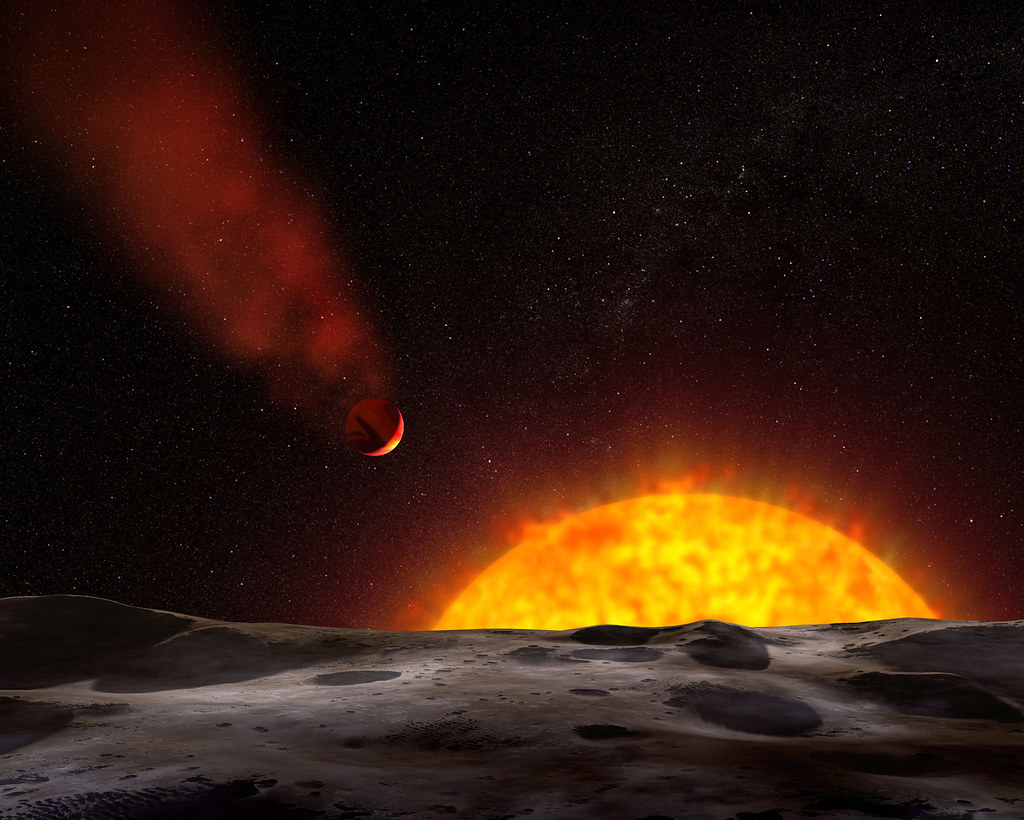
A Cosmic Feast 1,300 Light-Years Away
Imagine an event of unimaginable magnitude, unfolding thousands of light-years away. Here, a star, remarkably similar to our own Sun, was caught in the act of devouring one of its planets. This phenomenon, while violent and spectacular, offers scientists a rare glimpse into stellar dynamics.
The star in question, named TOI-5882, swallowed a planet that could have had a mass anywhere between Earth and Neptune. This observation was made possible by the chemical “fingerprint” left behind: a highly elevated lithium signature. The discovery occurred 1,300 light-years away from us, a distance that underscores the vastness of the universe and the challenges of observing such events.
Reconfirming a Spectacular Phenomenon
While TOI-5882 is a recent discovery, it is not the first time scientists have witnessed such an event. In 2020, an aging star designated ZTF SLRN-2020 was observed consuming a Jupiter-sized planet. This was the first direct detection of such an event, confirming that these “cosmic feasts” are not just theories but tangible realities.
These recent observations allow us to better understand the life cycles of stars and how planetary systems evolve. Until now, much of our knowledge about planetary destinies was based on theoretical models. Now, with directly observed data, we can refine these models and gain a clearer picture of what happens in the distant universe.
How Common Are These “Stellar Meals”?
A study published in Nature Astronomy suggests that approximately 27% of Sun-like stars may have consumed their own planets at some point in their existence. This percentage is surprisingly high and indicates that, while seemingly rare and dramatic, these events could be an essential part of the evolution of stellar systems.
These “stellar meals” are not just astronomical curiosities. They provide crucial clues about the future of our own solar system. In a billion years, as our Sun transforms into a red giant, it might, in turn, swallow Mercury, Venus, and possibly even Earth. Until then, we continue to gaze at the stars, learning from every new phenomenon we witness.
Did you know…?
- How many planets has our Sun devoured so far? So far, the Sun has not devoured any planets, but it is an event that could occur in the distant future.
- What is a lithium signature? Lithium is an element typically destroyed within stars, so its presence in high quantities on a star’s surface can indicate that it recently consumed planetary material.