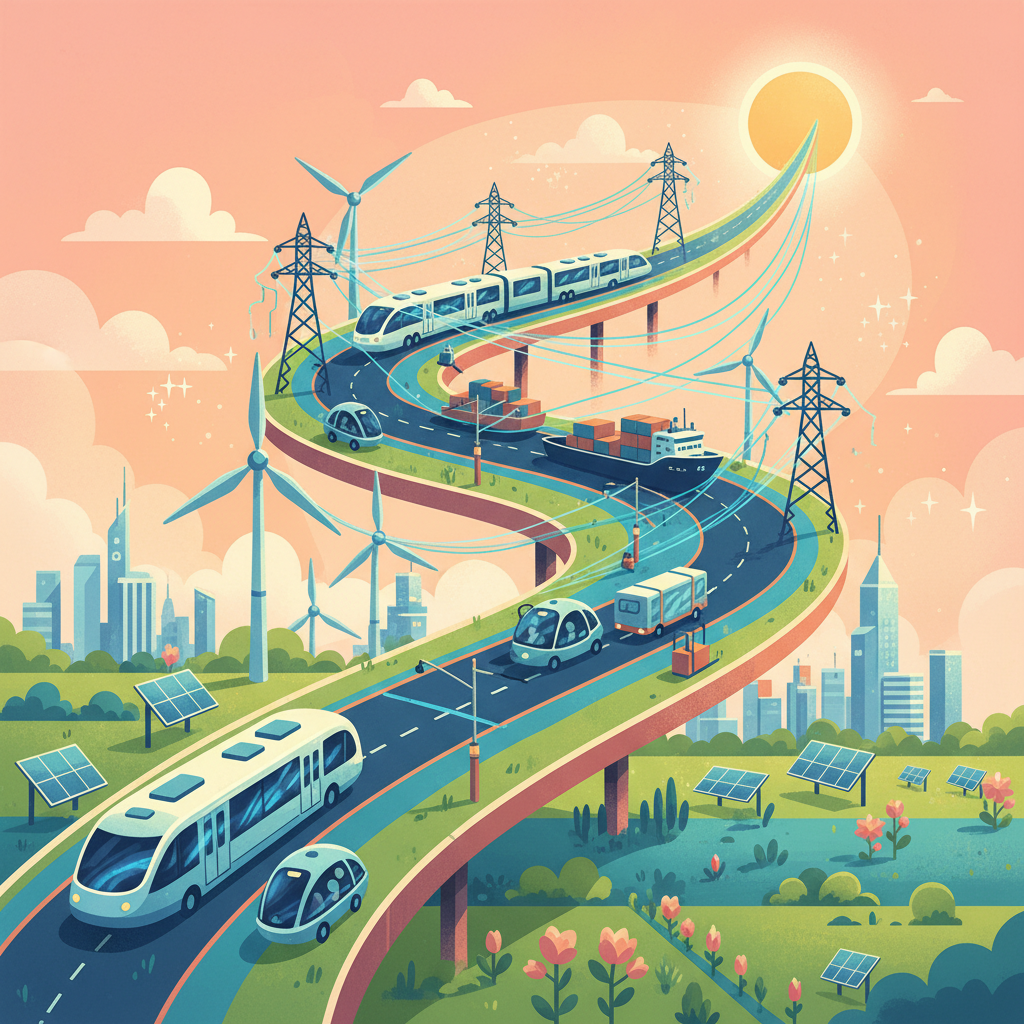
A Bright Future for Green Travel
For a long time, the collective imagination has been captivated by silently floating trains and aircraft leaving no polluting trails. Now, this future seems closer than ever, thanks to a new study that highlights the immense potential of superconducting technology. A recently published roadmap reveals how superconductors could completely revolutionize the transport sector, transforming it into a driving force for drastic carbon emission reductions.
Leading researchers, both from academia and industry, collaborated to develop this landmark document. Their conclusions are clear: superconductivity is not just another technology, but a fundamental pillar for large-scale electrification and, implicitly, for achieving ambitious decarbonization goals.
Gigaton Carbon Savings Anticipated
The potential impact of adopting superconductors is astonishing. According to the analysis, if just half of global transport systems were to integrate this technology, we could witness savings of up to 23 gigatons of carbon emissions in merely a quarter of a century. This figure is not only impressive but absolutely crucial in the fight against climate change. We are talking about quantities of greenhouse gases that would otherwise be released into the atmosphere, accelerating the global warming process.
From Vision to Reality: Zero-Emission Aircraft and Ships
The practical implementation of this roadmap would open new horizons. It would facilitate the transition to zero-emission aircraft, capable of long-distance flights without pollution. Furthermore, it would lead to significant improvements in the efficiency of maritime vessels, reducing fuel consumption and emissions. Last but not least, it would support the development of robust platforms for the use of liquid hydrogen as an energy source, another cornerstone in the future energy architecture. Essentially, the roadmap charts a clear path towards a cleaner, more efficient, and fundamentally more sustainable transport system.
Did you know…?
- What is a superconductor? It’s a material that, below a certain critical temperature, conducts electricity with absolutely no resistance, thus eliminating energy losses.
- How do superconductors help reduce emissions? By eliminating energy losses and enabling more efficient systems (such as more powerful electric motors for aircraft), the need for fossil fuels is significantly reduced.