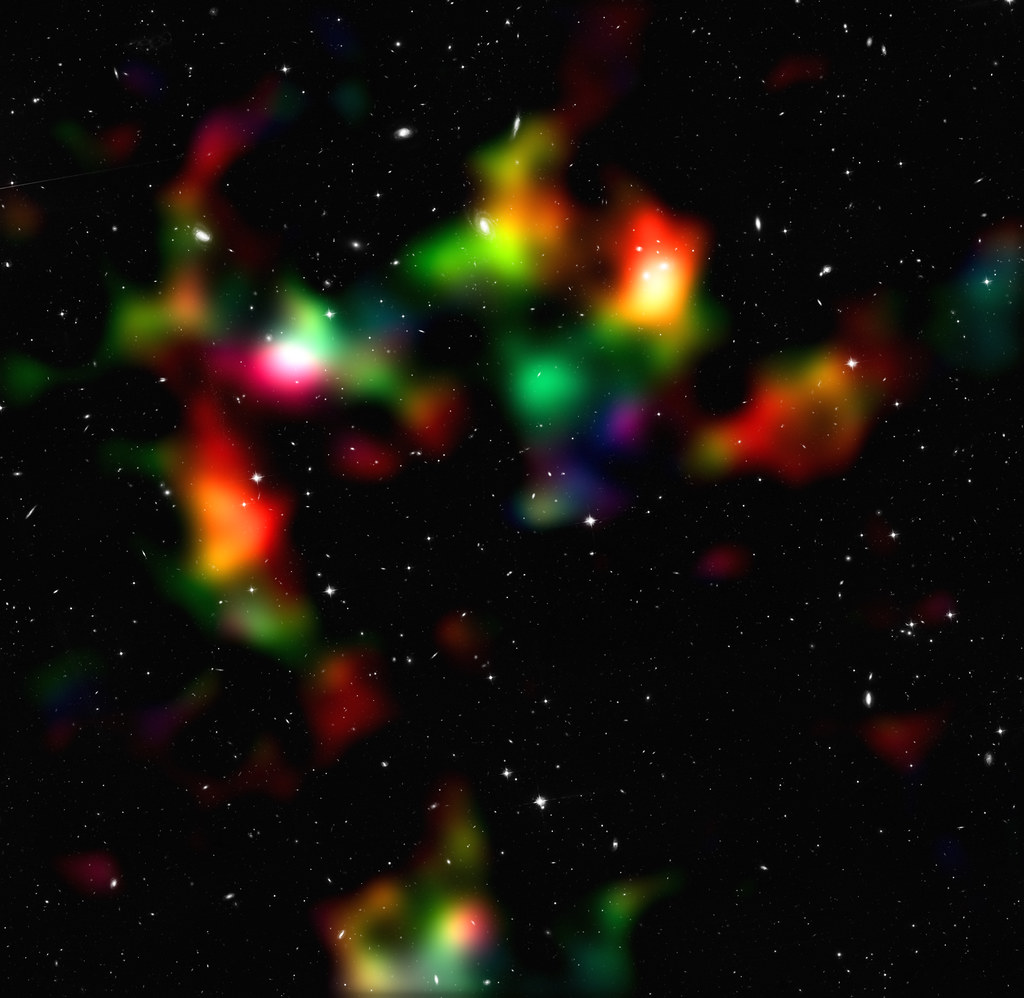
The universe is brimming with secrets, and one of the biggest is the nature of dark matter. This mysterious, invisible substance, which doesn’t interact with light, makes up a significant portion of the universe’s mass. While its presence is inferred from its gravitational effects, its internal mechanisms have remained a profound enigma.
Now, a team of researchers led by Hai-Bo Yu from UC Riverside has proposed a new theory – Self-Interacting Dark Matter (SIDM) – that could solve three fundamental cosmic puzzles. This innovative theory not only offers a fresh perspective on dark matter but could also change how we understand the structure and evolution of galaxies.
Self-Interacting Dark Matter: More Than a Gravitational Lullaby
The SIDM theory suggests that dark matter isn’t just a passive mass, but can interact with itself. Specifically, it might consist of two types of particles that gradually separate. These interactions could explain a range of observed phenomena across the cosmos.
The high density of dark matter in galaxy clusters, according to the SIDM theory, could account for observed gravitational effects, stellar streams, and the behavior of satellite galaxies. These phenomena have previously posed significant challenges to standard cosmological models.
From Distant Galaxies to Our Cosmic Neighbors
One of the most fascinating aspects of this new theory is its universal applicability. The mechanisms proposed by SIDM appear to work regardless of the scale we examine, from isolated galaxies to gigantic clusters of matter, and even within our own Milky Way galaxy and its satellite galaxies. This consistency across different levels of the universe makes it a promising candidate for a more complete explanation of cosmic mysteries.
If the theory proves correct, it could represent a major step forward in understanding the fundamental components of the universe and the forces that shape it.
Did You Know…?
- Q: How much of the universe is believed to be made of dark matter?A: It’s estimated that dark matter accounts for about 27% of the total mass-energy of the universe, while visible matter, which we can observe, constitutes only about 5%.
- Q: What is the main difference between dark matter and dark energy?A: Dark matter is a form of matter that interacts gravitationally but does not emit or absorb light. Dark energy is a hypothetical component that causes the accelerated expansion of the universe.